
Introduction
To date, much of my writing has focused on Māori political leadership and representation. I have also explored online harm, artificial intelligence, the emerging digital economy, Te Tiriti o Waitangi, constitutional change and the future of Māori development.
While these may appear to be separate conversations, they are connected by a common question:
How do Māori exercise authority in the systems that shape our future?
Whether those systems are political parties, government institutions, technology platforms, workplaces or unions, the underlying challenge remains remarkably consistent: who holds power, who sets the rules, and how do Māori ensure our voices are reflected in the decisions that shape our collective future?
This article, written in my capacity as Acting President of Te Rōpū Kaimahi Māori o Aotearoa, continues that exploration through the lens of Māori workers.
Forty years ago, Māori union organisers gathered in Rotorua to debate fundamental questions of representation, rangatiratanga and the future of Māori worker organisation. Four decades later, many of those same questions remain unresolved.
The question is not whether change is coming.
The question is whether Māori will help shape it.
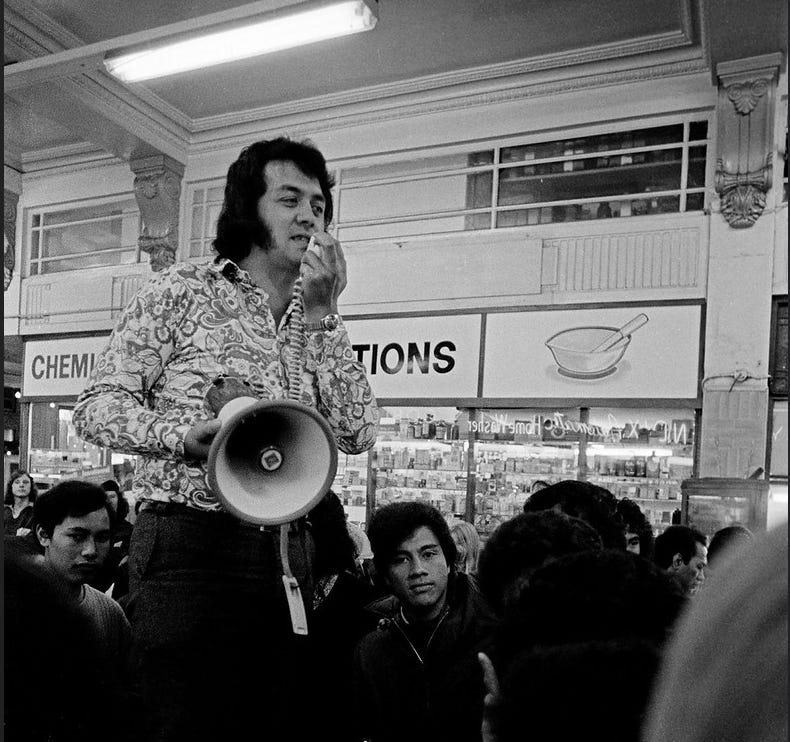
Image Syd Jackson - St Kevin’s Arcade, at the support rally for Maori Language Day, 14/9/1972 - photo courtesy John Miller
The Legacy We Inherited
I entered the union movement believing in solidarity.
As the first Māori woman organiser for the Public Service Association, I witnessed firsthand the power of workers standing together. I saw people challenge intimidation, poor conditions, racism and exploitation. Most importantly, I learned that collective action, at its best, is an expression of human dignity.
I was fortunate to enter that world under the guidance of leaders who shaped my understanding of both politics and power. Joris de Bres modelled a form of tangata Tiriti leadership grounded in humility, accountability and a genuine commitment to social justice. My uncle, Syd Jackson, brought something different. He carried into the labour movement the political clarity forged through Ngā Tamatoa, Treaty activism and Māori liberation struggles.
Uncle Syd often remarked that he would rather deal with a roaring racist than a bleeding-heart liberal because in his words ‘you knew who the enemy was’.
What some interpreted as provocation was, in reality, a lesson about power. Institutions often find it easier to speak the language of justice than to confront the structural changes necessary to achieve it. The challenge for Māori has never simply been gaining a seat at the table. It has been ensuring that participation translates into meaningful influence and lasting change.
That lesson is one reason the re-emergence of Te Rōpū Kaimahi Māori should not surprise anyone familiar with the history of Māori workers in this country. The questions that gave rise to TRKM are not new. They are the continuation of conversations that Māori workers have been having for generations.
The House Māori Workers Built
Much of modern Aotearoa was built on Māori labour.
Māori workers stood at the centre of some of the most important industrial struggles in this country’s history. They worked in the forests, the freezing works, on the wharves, on the railways, in manufacturing, construction, transport and the public service. Their labour helped build the economic foundations of modern New Zealand.
Yet the struggles of Māori workers were never solely about wages and conditions. They were also about dignity, identity, language and culture. They were about the right to bring our full selves into workplaces that often expected us to leave our Māoritanga at the gate.
The gains secured by Māori workers were hard fought. Tangihanga leave, recognition of te reo Māori, cultural leave provisions and greater awareness of tīkanga in workplaces did not emerge by accident. They were won through the determination of generations of Māori workers and organisers who refused to accept that participation required assimilation.
By the mid-1980s these questions were being debated openly. Māori organisers/unionists were asking whether mainstream union structures genuinely reflected rangatiratanga or merely incorporated Māori participation into predominantly Pākehā political and industrial institutions. The debate was not about rejecting solidarity. It was about asking whether solidarity and self-determination could genuinely coexist.
Those conversations culminated in the first national Hui a Ngā Kaimahi Māori o Aotearoa held in Rotorua in mid 1986. Nearly 400 delegates travelled from across the country, carrying the experiences of workers from factories, meat works, dockyards, hospitals, government departments, forests, railways and communities. They came together to debate questions that sat at the intersection of worker rights, Māori aspirations and political authority.
Forty years later, many of those same questions remain unresolved.
The Original Kaupapa
Some people see Te Rōpū Kaimahi Māori as something new. In reality, it is the continuation of a much older conversation.
As Māori communities absorbed the impacts of Rogernomics, privatisation and labour market deregulation during the 1980s and 1990s, discussions were already occurring about the need for a distinctly Māori worker organisation grounded in Te Tiriti o Waitangi, tīkanga Māori and rangatiratanga. The names may have changed and the circumstances have certainly evolved, but the underlying questions never disappeared. Māori workers continued to ask who held authority, what solidarity meant when viewed through the lens of Te Tiriti, and whether worker organising could genuinely reflect Māori aspirations without Māori exercising meaningful influence over its direction.
At the heart of Syd Jackson’s political philosophy was a simple but profound observation: Māori workers are not simply another constituency within the labour class movement. We are tangata whenua. His commitment to worker solidarity was unwavering, but he never believed solidarity required Māori to surrender their right to self-determination.
That distinction remains as relevant today as it was forty years ago.
Echoes of an Earlier Era
For many Māori workers, the current political and economic environment feels uncomfortably familiar.
The reforms of the 1980s and 1990s reshaped Aotearoa in ways that are still felt today. State assets were sold. Public services were restructured. Stable employment disappeared across entire industries. Union membership declined sharply. Communities that had relied upon secure work in forestry, rail, roadworks, manufacturing, freezing works and the public sector experienced profound economic and social disruption.
Māori carried a disproportionate share of those impacts.
Communities lost not only jobs, but the social infrastructure and sense of collective purpose that employment provides. The effects can still be seen in the statistics that continue to concern Māori leaders today: persistent disparities in income, employment, health, housing and educational achievement.
That is why many Māori workers look at the current environment and see echoes of an earlier era. Once again we are witnessing significant public sector restructuring. Once again there is pressure on worker protections and collective bargaining. Once again economic efficiency is being prioritised over social wellbeing. Once again Te Tiriti o Waitangi and the place of Māori within our constitutional arrangements have become subjects of political contest.
And once again Māori women are often among those most affected. The recent dismantling of the pay equity regime by this Coalition government demonstrated how quickly gains secured over decades of advocacy can be reversed. For many Māori women workers, it served as a reminder that progress is never guaranteed and that rights once won can still be lost.
History never repeats itself exactly, but the underlying pattern is familiar. When governments seek to reduce the role of the state, restructure public services and narrow the scope of Treaty obligations, Māori communities often experience the consequences more acutely than others because of our existing social and economic vulnerabilities. Māori unionists/organisers gathered in Rotorua forty years ago because they understood that economic change, political power and constitutional recognition could not be separated from one another. They understood that decisions made in Parliament eventually found their way into workplaces, homes and communities.
Beyond Representation
The re-emergence of Te Rōpū Kaimahi Māori is not ultimately about one organisation. Nor is it about personalities or political allegiances. It reflects a deeper question that Māori workers, unions and iwi leaders have been grappling with for generations.
How do we honour both solidarity and rangatiratanga?
Over the past three decades, unions, government agencies and many public institutions have increasingly adopted the language of biculturalism, diversity, inclusion and equity. Much of this work has been genuine, necessary and hard won. Yet many Māori workers continue to ask a deeper question.
Does participation necessarily translate into authority?
The challenge is not whether Māori are present within institutions. It is whether Māori are able to exercise meaningful authority within them. Institutions have become comfortable with Māori presence and Māori perspectives, but far less certain about how to respond when Māori seek to exercise rangatiratanga within those same structures.
The re-emergence of Te Rōpū Kaimahi Māori should not be viewed as a rejection of the broader labour movement. Many of us came from that movement. We organised within it, learned from it and helped build it. Rather, it reflects an ongoing search for organising models grounded in tīkanga Māori, collective responsibility and constitutional recognition while remaining committed to the wellbeing of working people.
A union organisation cannot speak credibly to Treaty policy or partnership if it does not fundamentally understand that this is what mana motuhake means for Māori — the right to define our own direction, not merely to participate in someone else’s.
Rotorua, Forty Years On
There is a certain historical symmetry that has not been lost on me. Forty years ago Māori unionists/organisers gathered in Rotorua to debate questions that continue to resonate today: the place of Māori within the labour movement, the meaning of rangatiratanga in the workplace, and whether Māori workers required organising structures grounded in kaupapa Māori and Te Tiriti o Waitangi. The questions they raised have travelled across four decades.
It is therefore particularly poignant that one of the leaders who helped support the contemporary relationship between iwi leadership and Te Rōpū Kaimahi Māori was Dr Kenneth Kennedy, Chair of Te Arawa Lakes Trust who passed away earlier this year.
Dr Kennedy understood that the wellbeing of Māori workers could not be separated from the wellbeing of whānau, hapū and iwi. That conviction took concrete form. On 28 October 2025, iwi and unions stood together for the first time on a national scale at Rā Whakamana — the day we tested whether the iwi movement and the union movement could work as one to ensure this coalition government served only a single term. Working alongside Ngāti Porou Deputy Chair Na Raihania, Dr Kennedy helped carry that relationship forward, and at the Waitangi National Iwi Chairs Forum hui of 5 February 2026 the formal relationship between the Forum and Te Rōpū Kaimahi Māori was confirmed, with Na Raihania and Dr Kennedy himself appointed to work alongside TRKM. He recognised that the aspirations of Māori workers and the aspirations of iwi were not competing interests, but part of the same kaupapa.
I do not know whether Dr Kennedy would have viewed that connection as significant. Yet there is something fitting in the fact that forty years after Māori workers gathered in Rotorua to debate the future of Māori worker organisation, one of the strongest advocates for strengthening the relationship between iwi and workers came from Rotorua, Te Arawa, itself.
Perhaps that serves as a reminder that while generations pass and circumstances change, some conversations endure. The challenge before us is not simply to remember them, but to continue their legacy.
Homes, Not Houses
During the recent joint Post Budget briefing co-hosted by the National Iwi Chairs Forum and Te Rōpū Kaimahi Māori, at Parliament, Na Raihania made an observation that stood out to me. He reminded us that Māori workers did not simply build houses in this country.
The wages earned by our parents and grandparents did far more than pay mortgages or keep food on the table. They sustained marae, supported whānau, enabled participation in hapū and iwi life, and created opportunities for future generations. In that sense, what Māori workers built was never simply a collection of houses.
We built homes.
Employment has never been solely about income. For Māori, work has always been connected to whānau wellbeing, cultural continuity, community leadership and collective prosperity. When employment is undermined, the consequences extend well beyond the individual worker. Whānau lose stability, marae lose contributors, communities lose leaders and rangatahi lose examples of meaningful participation.
For those interested, a recording of the Post Budget Briefing can be viewed here:
The Election Before Us
As Aotearoa moves toward another election, Māori workers should be asking more of political parties than promises and slogans. We should expect credible plans for reducing Māori unemployment, stronger protections for workers facing economic restructuring, and an honest reckoning with the changes that artificial intelligence and automation will bring to the work our people do.
Equally important is an honest discussion about Te Tiriti o Waitangi and the place of Māori aspirations within the constitutional future of Aotearoa.
The reality is that Māori workers have experienced disappointment under governments of different political persuasions. Some have actively pursued policies that weakened worker protections and reduced Māori influence. Others spoke the language of transformation but struggled to deliver meaningful structural change, even when presented with historic opportunities to do so. That history should encourage us to ask harder questions of all political parties rather than assume any particular party has earned our loyalty.
The challenge before Māori workers is not simply deciding who to vote for. It is ensuring that our aspirations are visible within the policy platforms of those seeking to govern. If our concerns about employment, housing, education, constitutional recognition and economic participation are absent from party manifestos, we should not be surprised when they are absent from government priorities.
Equity, Equality and the Unfinished Task
Uncle Syd often challenged us to look beyond the language institutions used and instead examine the outcomes they produced. Today we hear much about diversity, inclusion and equity. Those conversations matter, but Māori workers should also be asking where that equity is taking us.
If it does not ultimately result in greater equality of opportunity, equality of participation and equality of influence, then it risks becoming another mainstream process rather than a pathway to transformation.
For Māori workers, the measure of success cannot simply be whether we are consulted more often or represented on more committees. The measure must be whether our whānau are better off, whether our rangatahi have meaningful pathways into secure employment, whether Māori are participating in the industries and technologies shaping the future, and whether our people are able to exercise rangatiratanga over the decisions that affect their lives.
This is a challenge Māori workers are entitled to put to the union movement as well — the movement many of us helped build. Freedom of association is one of its foundational principles, and multi-union worksites are not uncommon; workers have always been free to organise in the form that best represents them, and unions have fought hard to defend that very freedom.
So when a Māori workers’ organisation emerges, grounded in Te Tiriti and tikanga, it is simply that principle exercised — the same freedom the movement has always defended, claimed by Māori on Māori terms. Seen that way, the deeper question was never really about union structures. It was about authority — about who is expected to organise within someone else’s framework, and who is able to define their own. That is a question the labour movement, of all movements, is well placed to examine honestly.
That is the unfinished task.
Because equity should never become the destination. Its purpose is to move us closer to equality.
The Next Forty Years
The house Māori workers built still stands.
Its foundations can be found in the forests, freezing works, factories, railways, hospitals, schools, public services and communities that generations of our people helped create. The responsibility we inherit is not simply to defend that legacy, but to build upon it.
Our rangatahi are inheriting the outcomes of decisions they did not make. Yet they are also inheriting the legacy of generations of Māori workers who organised, advocated and fought for identity, dignity and opportunity. The future of work is being reshaped by artificial intelligence, automation and global economic change, and iwi are becoming increasingly significant economic actors. The challenge before us is not simply to defend what previous generations achieved, but to ensure Māori workers, whānau and iwi are actively shaping what comes next.
That means building leadership pathways, investing in political education and workforce development, and ensuring Māori workers have a voice in the industries and technologies that will define the next generation.
Most importantly, it means participating.
Workers, Iwi and the Future Economy
The landscape facing Māori workers today is fundamentally different from that of forty years ago. Across Aotearoa, iwi have emerged as significant economic actors, collectively managing assets worth many billions of dollars and playing an increasingly important role in regional development, housing, education, environmental stewardship and employment.
This presents opportunities that previous generations of Māori workers could scarcely have imagined. Yet it also raises important questions. Economic success alone cannot be the measure of Māori progress. The challenge is ensuring that Māori economic development remains connected to the wellbeing of whānau, hapū and communities, rather than simply replicating models that concentrate wealth and opportunity in the hands of a few.
Uncle Syd often reminded us that Māori aspirations were never about creating a brown version of the existing system. The struggle was not simply for Māori participation in economic structures, but for the transformation of those structures so they better reflected our values of collective responsibility, reciprocity and intergenerational wellbeing.
As iwi economies continue to grow, the relationship between iwi, workers and whānau becomes increasingly important. The question is not whether iwi should be successful economic enterprises. The question is how that success contributes to secure employment, workforce development, fair work practices, affordable housing, educational opportunity and pathways for future generations of Māori.
The first generation fought to ensure Māori workers had a voice within the economy. Our challenge is to ensure that the economic power Māori have since built is used in ways that strengthen our people, our communities and our collective future.
Whether you are a union member, an iwi leader, a trustee, a director, a public servant, a tradesperson, a teacher, a nurse, a cleaner, a contractor, a business owner or a rangatahi preparing to enter the workforce, there is a place for you in that conversation.
The lesson of the last forty years is that progress is never guaranteed. Rights can be advanced, but they can also be eroded; recognition can expand, but it can also contract. The questions raised forty years ago in Rotorua remain as relevant as ever. The challenge before us is not whether Māori workers still possess collective power. The question is whether we are prepared to organise that power for the benefit of future generations.
If you would like to be part of that conversation, learn more about Te Rōpū Kaimahi Māori, share your ideas, or explore membership at www.trkm.org.nz.
The house Māori workers built still stands.
Our responsibility is to ensure that those who come after us inherit something even stronger.
He kaupapa, ehara i te tangata.
He Mihi Poroporoaki
E te rangatira, e te pou o Te Arawa, e te matua, e Dr Kenneth Kennedy, haere, haere, haere atu rā.
E kore e mimiti ngā mihi mō tō tautoko i ngā kaupapa i whai kia whakakaha ake i te mana o ngā kaimahi Māori me ngā iwi. I mārama koe, ehara ēnei i ngā kaupapa wehewehe, engari he kaupapa kotahi e whai ana i te oranga o te whānau, te hapū me te iwi.
Moe mai rā e te rangatira. Kua hoki koe ki te kāinga tūturu o te tangata. Waiho mai ngā mahi mā mātou e kawe tonu.
Haere atu rā ki te pō.
Haere atu rā ki ō tīpuna.
Haere atu rā.
Moe mai rā.